
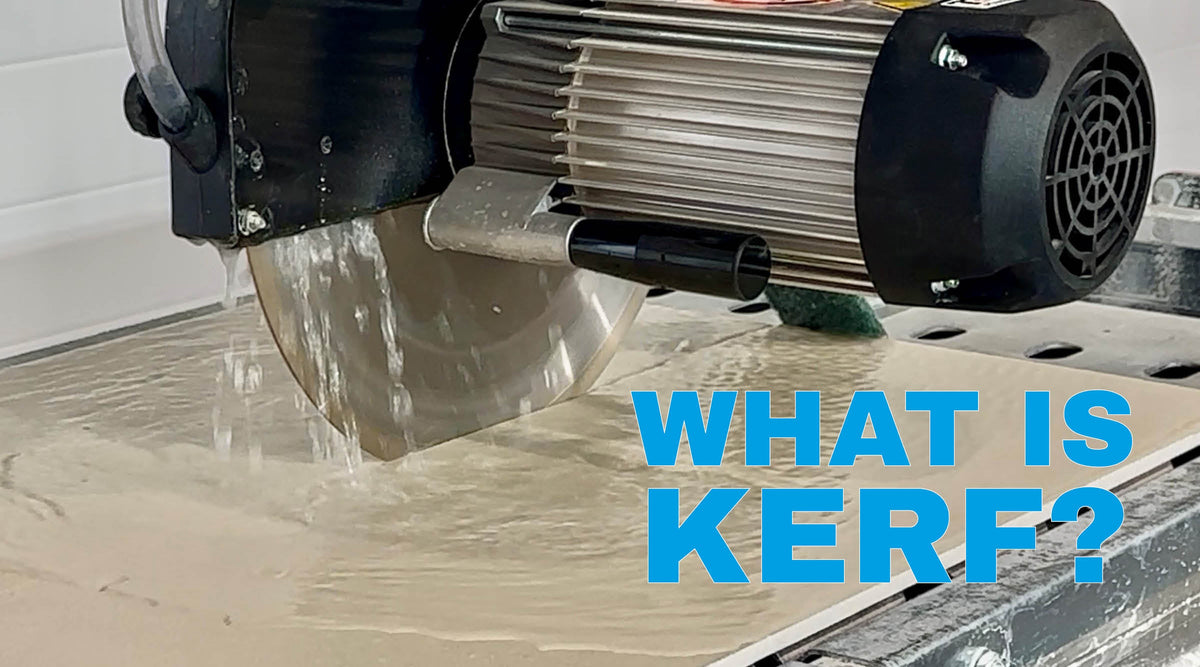
What Is Blade Kerf and Why Does It Matter?
When selecting a diamond blade, most people concentrate on the blade diameter, bore size and the material it is designed to cut. One measurement that is often overlooked is the kerf.
Understanding kerf can improve cutting accuracy, reduce wasted material and help you choose the correct blade for the work being completed.

What is kerf?
Kerf is the width of material removed by the blade as it passes through a tile, porcelain slab or piece of natural stone.
It is easy to assume that the kerf will always be identical to the stated thickness of the blade. In practice, the finished cut may be slightly wider.
For example, a blade with a cutting width of approximately 2.4mm could produce a kerf measuring around 3mm.

The actual kerf can be influenced by several factors, including:
-
The width and design of the diamond rim or segments
-
Normal manufacturing tolerances
-
Blade movement or runout
-
The condition of the machine and bearings
-
Incorrectly fitted or dirty flanges
-
Cutting pressure and feed speed
-
The hardness and thickness of the material
-
Minor chipping along the cut
-
The amount and direction of water reaching the blade
The figure printed on the blade should therefore be treated as an important specification, but not as a guarantee that every completed cut will have exactly the same width.
Why does kerf matter?
Kerf matters whenever the amount of material removed affects the finished dimensions of the piece.
If a cut is made directly along the required measurement, part of the finished piece will be removed by the blade. A 3mm kerf could leave the tile or slab approximately 3mm smaller than intended, depending on which side of the marked line the blade follows.
The blade should normally cut on the waste side of the line, leaving the required measurement intact.
Kerf is particularly important when producing:
-
Repeated pieces that must remain the same size
-
Narrow strips
-
Mitres and finished external corners
-
Decorative details
-
Cut-outs around fittings
-
Book-matched or patterned installations
-
Pieces positioned beside trims or fixed features
-
Visible edges with very small tolerances
A few millimetres may make little difference during rough preparation, but they can be clearly noticeable in precision work.
When does kerf matter less?
Kerf does not affect every cut to the same degree.
It may be less important when:
-
The cut edge will be hidden beneath a trim
-
The cut will be covered by another tile or building element
-
The piece is being roughly sized before a final finishing cut
-
The removed section is waste material
-
Sufficient movement-joint or installation allowance has already been included
-
The project does not require a tightly controlled finished measurement
Kerf still exists in these situations, but its effect may not influence the appearance or performance of the completed installation.
Segmented blades for fast, repetitive cutting
Segmented diamond blades are particularly effective when speed and productivity are the main priorities.
The spaces between the segments often called "gullets" help water, slurry and loose material move away from the cutting area. They also assist with cooling and expose the material to a more aggressive cutting action.
This makes a suitable segmented blade a strong choice for:
-
Repeated straight cuts
-
Thick porcelain paving
-
Landscaping projects
-
High-volume cutting
-
Dense materials
-
Work where productivity is more important than producing the finest possible exposed edge
A segmented blade may have a wider kerf than a fine continuous rim blade, but this is not necessarily a disadvantage. When the cut is correctly marked and the kerf is allowed for, the blade can provide faster and more efficient repetitive cutting.
Continuous-rim blades for precision work
A thinner continuous rim diamond blade is often the better choice when accuracy and the appearance of the finished edge are more important than maximum cutting speed.
Because the diamond rim is continuous, it can provide a smoother cutting action with reduced edge chipping when used correctly with a suitable machine and adequate water supply.
Continuous-rim blades are particularly useful for:
-
Detailed cutting
-
Small or narrow pieces
-
Visible edges
-
Precision cut-outs
-
Fine finishing work
-
Areas where the completed cut will remain exposed
The thinner kerf also removes less material, which can make it easier to maintain an exact finished measurement.
However, a thinner blade should not automatically be considered suitable for every task. It may cut more slowly in thick, dense material and can be more sensitive to twisting, side pressure or an incorrectly aligned machine.
Speed or precision: choosing the correct blade
The best blade is not always the blade with the narrowest kerf.
For fast, repetitive cuts through thick porcelain paving, a suitable segmented blade may be the more productive option. Its design helps clear material from the cut and manage the demands of continuous professional use.
For detailed work or a highly visible finished edge, a thinner continuous-rim blade may provide the greater control and cleaner finish required.
In simple terms:
-
Choose a suitable segmented blade when speed, material clearance and repetitive cutting are the priorities.
-
Choose a suitable continuous rim blade when precision, reduced chipping and the appearance of the finished edge are the priorities.
Check the actual kerf before beginning
Before completing an important cut, make a test cut in a spare piece of the same material.
Measure the actual kerf and inspect the finished edge. This will show how the blade, material, machine, water supply and cutting technique are working together.
For repetitive work, use a physical stop or guide based on the finished size of the retained piece rather than relying only on repeated pencil measurements.
Always inspect the blade and machine before use, confirm that the blade is compatible with the equipment and material, and follow the blade and machine manufacturer’s instructions. BOSS Blades™ recommends wet cutting with an adequate continuous water supply and the correct personal protective equipment.
Share:
Why Does a Diamond Blade Stop Cutting?
Why Diamond Mesh Matters More Than Blade Thickness