
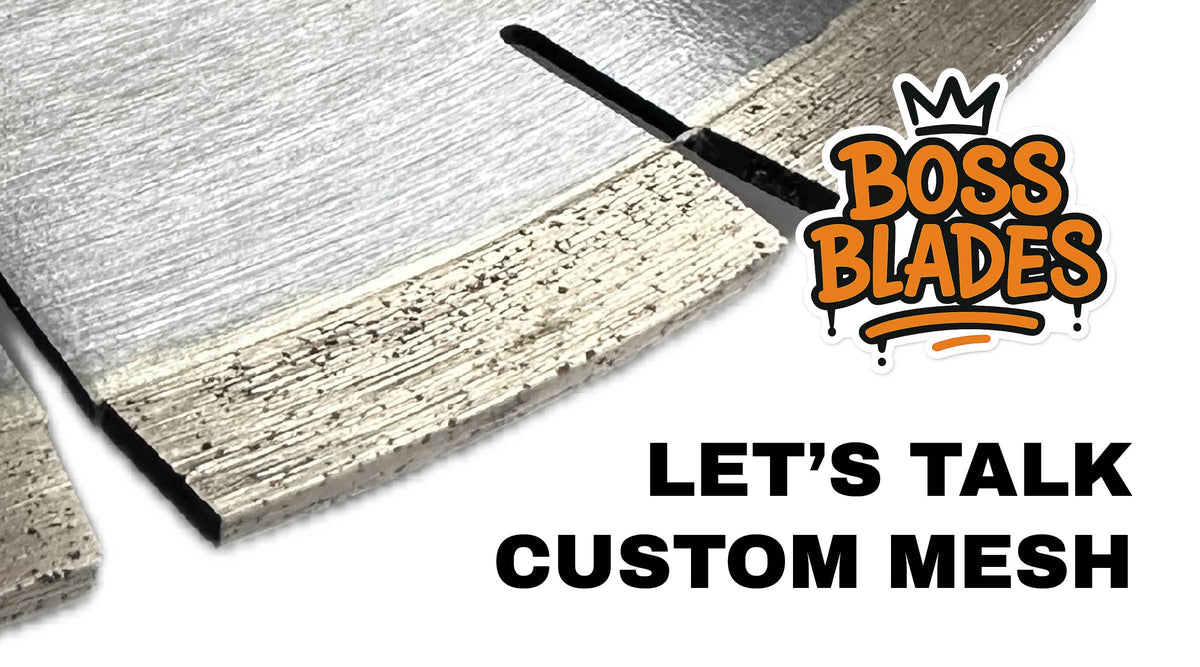
Why Diamond Mesh Matters More Than Blade Thickness
A thin diamond blade is often assumed to produce a clean, chip free cut. Although blade thickness can influence cutting resistance, accuracy and the amount of material removed, it does not determine the finished cut on its own.
The size and quality of the diamond particles, their concentration, the surrounding bond and the construction of the cutting rim all contribute to how a blade performs.
This is why BOSS Blades™ does not rely on one standard diamond mesh across its entire range. The diamond specification is selected to suit the material, machine and intended type of cut.
What is diamond mesh?
Diamond mesh describes the approximate size range of the diamond particles used within the blade’s cutting rim or segments.
In general:
-
A finer mesh contains smaller diamond particles and can help produce a smoother finish in materials where edge quality is important.
-
A coarser mesh contains larger diamond particles and may provide a more aggressive cutting action where speed and material removal are the priorities.
However, mesh grade cannot be considered in isolation. The bond holding the diamonds, the concentration of diamond, the segment design, the blade speed, the machine and the material being cut all affect the final result.
A professional blade must therefore be designed as a complete system.
Why a thin blade is not automatically chip-free
A thinner blade produces a narrower kerf and removes less material, but that does not guarantee a chip free edge.
A thin blade using an unsuitable diamond mesh or bond could still chip the material, cut slowly, glaze prematurely or wear unevenly. It may also deflect if used with excessive pressure or on an unsuitable machine.
Likewise, a slightly thicker blade with the correct diamond specification, a stable steel core and an appropriate cutting rim may produce a cleaner and more controlled cut.
The finished result depends on the complete blade specification, including:
-
Diamond particle size
-
Diamond quality and concentration
-
Metal-bond formulation
-
Rim or segment design
-
Core stability
-
Blade thickness
-
Machine condition and alignment
-
Feed speed and cutting pressure
-
Water supply
-
The type and thickness of material
Thickness is therefore only one part of the blade-selection process.
Selecting the mesh for the material
Different materials respond differently to the cutting action of a diamond blade.
Dense porcelain, ceramic tiles, natural stone and concrete do not have the same structure or cutting characteristics. A blade designed to cut one material quickly may not provide the best finish or working life in another.
For example, a blade intended for precision cutting in porcelain may use a finer diamond specification to help control edge chipping. A blade intended for demanding groundwork or concrete cutting may require a more aggressive specification, a different bond and a segment design that clears debris efficiently.
BOSS Blades™ selects the diamond mesh and construction to suit the intended application rather than applying one generic specification to every blade.
The bond is as important as the diamond
The metal bond surrounds and supports the diamond particles within the cutting rim or segment.
As the blade cuts, the bond must wear at a controlled rate so that worn or blunt diamonds are released and fresh cutting diamonds become exposed.
If the bond is too hard for the material and operating conditions, the blade can glaze and stop cutting efficiently. If it is too soft, the cutting rim may wear unnecessarily quickly.
This means that two blades containing a similar diamond mesh can still perform very differently if their bond formulations are not the same.
The correct combination of diamond mesh, concentration and bond determines whether the blade is designed primarily for:
-
Fine edge quality
-
Fast material removal
-
Long working life
-
Dense porcelain
-
Ceramic tiles
-
Natural stone
-
Concrete or masonry
-
Wet or approved dry-cutting applications
How the cutting segments are attached
The way the cutting rim or individual segments are applied to the steel core also helps determine the blade’s intended use.
Different manufacturing methods include sintering, brazing and laser welding. Each has suitable applications when the blade is correctly designed, manufactured and used within its stated limits.
Vacuum brazed diamond blades
A vacuum brazed blade or tool normally has diamond particles brazed directly to its working surface. This leaves the diamonds highly exposed and can create an aggressive cutting action.
Vacuum brazed products can be effective for specialist cutting, grinding or shaping applications and for working across certain mixed materials. However, their exposed diamond layer and construction generally give them different cutting and wear characteristics from a multi-layer sintered segment.
They should be selected according to their stated application rather than being treated as a universal substitute for every type of diamond blade.
Laser welded segments
With a laser welded blade, the segments are joined to the steel core using a high strength welding process.
This creates a strong connection between the segment and the core, helping the blade withstand the heat, resistance and repeated loading associated with demanding professional cutting.
Laser welded segmented blades are particularly well suited to applications such as:
-
Repetitive cutting
-
Thick porcelain paving
-
Dense construction materials
-
Concrete and masonry
-
Landscaping and groundwork
-
High load professional cutting
The strong segment-to-core connection reduces the risk of segment loss when the blade is correctly selected and used. However, every blade regardless of how it is manufactured must still be inspected before use and operated within its specified maximum RPM and intended application.
The complete specification determines performance
There is no single measurement that identifies the best blade.
A very thin blade is not automatically a precision blade. A coarse or segmented blade is not automatically unsuitable for porcelain. A fine mesh does not guarantee good results if the bond, core, machine or cutting technique is incorrect.
The correct blade is produced by matching all the important elements:
-
The diamond mesh to the material and required finish
-
The bond to the material and operating conditions
-
The rim or segment design to the required cutting speed
-
The method of attachment to the expected working load
-
The steel core to the diameter, machine and required stability
This application-specific approach is what separates a purpose-designed professional blade from a generic blade produced to cover as many materials as possible.
Choosing the right BOSS Blade
Before choosing a blade, consider:
-
What material is being cut?
-
How thick is the material?
-
Is the finished edge exposed?
-
Is speed or edge quality the priority?
-
Will the work involve occasional cuts or continuous production?
-
What machine, bore size and maximum RPM are required?
-
Is the blade designed for wet cutting?
BOSS Blades™ selects the diamond mesh, bond, cutting rim construction and core specification according to the intended material and application. This means each blade can be chosen for the work it was designed to perform rather than relying on thickness alone.
Always follow the blade label and machine manufacturer’s instructions. Inspect the blade before every use, use the correct guards and personal protective equipment, and provide the specified water supply. Never use a damaged, unsuitable or incorrectly fitted blade.
Share:
Diamond Blade Kerf Explained: When It Matters and How to Choose the Right Blade